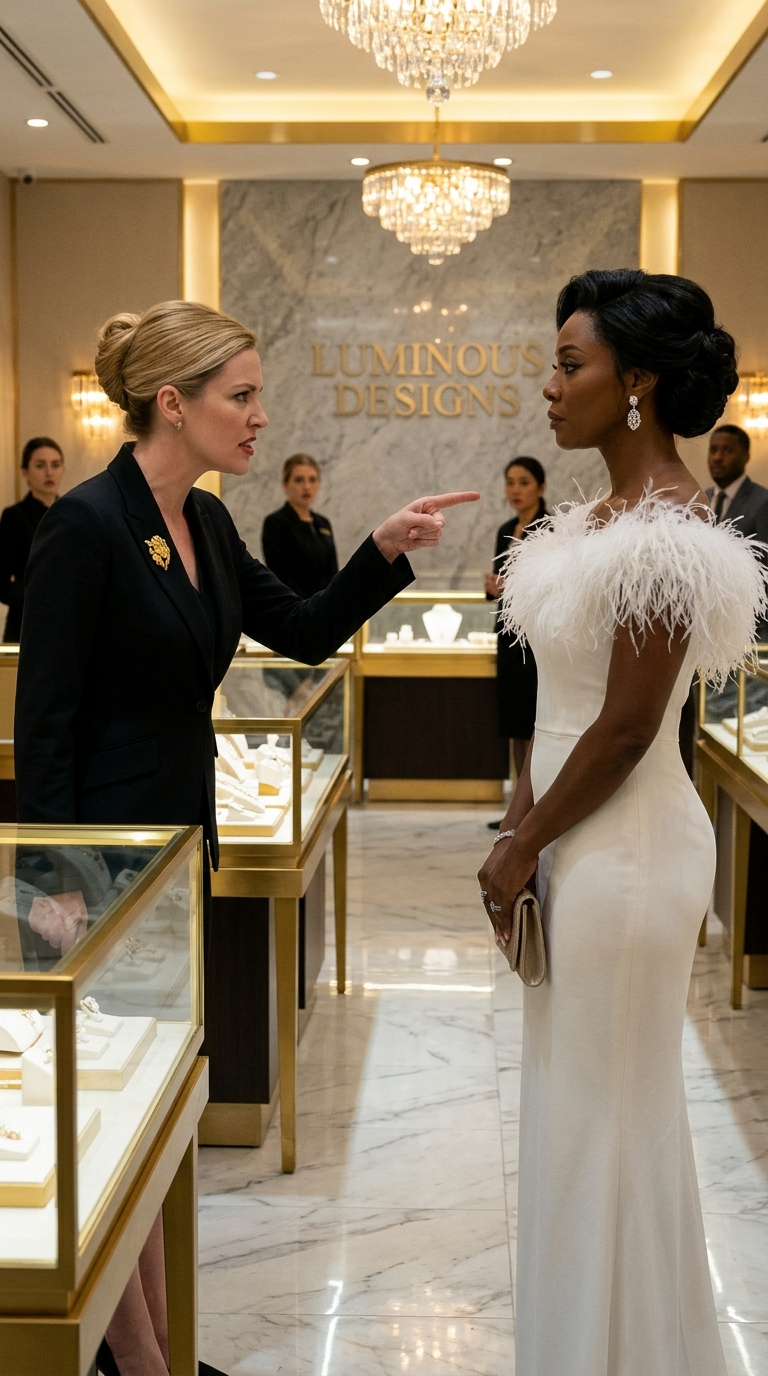
The associate shot him an irritated glance. Nevertheless, she could hardly object without making her refusal even more conspicuous.
“Fine,” she said sharply. “I’ll check with management.”
She turned toward the back office, leaving the customer beside the diamond display.
However, before the associate could disappear behind the doorway, the woman spoke again.
“One more thing.”
The employee stopped.
“Please don’t confuse my patience with permission to disrespect me.”
The associate turned slowly, and for the first time, her confident expression faltered.
Chapter 4: The Cost of Being Wrong
A Manager Enters the Conversation
The associate returned several moments later with the boutique manager, a middle-aged man wearing a dark navy suit and a discreet gold lapel pin.
“What seems to be the difficulty?” he asked, looking between the two women.
The sales associate immediately adopted a polished, reassuring tone.
“This customer requested access to the VIP collection. I explained that we generally reserve it for established clients.”
“Generally?” the woman in white repeated.
The manager looked at her.
“May I ask what happened?”
“Of course,” she replied. “I asked to see the collection in the back. Your associate told me that it was for VIP clients, not walk-ins with no purchase history. When I asked about the requirements, she suggested I look at jewelry more appropriate for my budget.”
The manager’s expression changed.
Although he maintained his professional composure, he turned toward the associate with a question in his eyes.
“Did you ask what she was interested in purchasing?”
The associate folded her gloved hands.
“I was attempting to guide her toward suitable options.”
“That wasn’t my question,” he said.
For the first time since the confrontation began, the sales associate appeared uncertain.
“No,” she admitted. “I didn’t.”
“Did she ask for a discount?”
“No.”
“Did she behave inappropriately?”
The associate glanced toward the security guard.
“No.”
The manager exhaled slowly. Meanwhile, the woman in white waited without interrupting, allowing the employee’s own answers to establish what had happened.
“Then why did you direct her toward less expensive pieces?” he asked.
“I thought it would be more efficient.”
“Based on what information?”
The question hung in the air.
There was no purchase history to review, no stated budget to consider, and no unusual demand to resolve. The associate had made a judgment before establishing a single relevant fact.
Consequently, the explanation she had prepared began to collapse.
A Question of Standards
The manager turned back to the customer.
“I apologize for the way you’ve been treated. Our policies should never be used to make assumptions about someone’s financial circumstances.”
“Thank you,” she replied. “I don’t expect special treatment. I expect the same courtesy you’d offer anyone who walks through those doors.”